
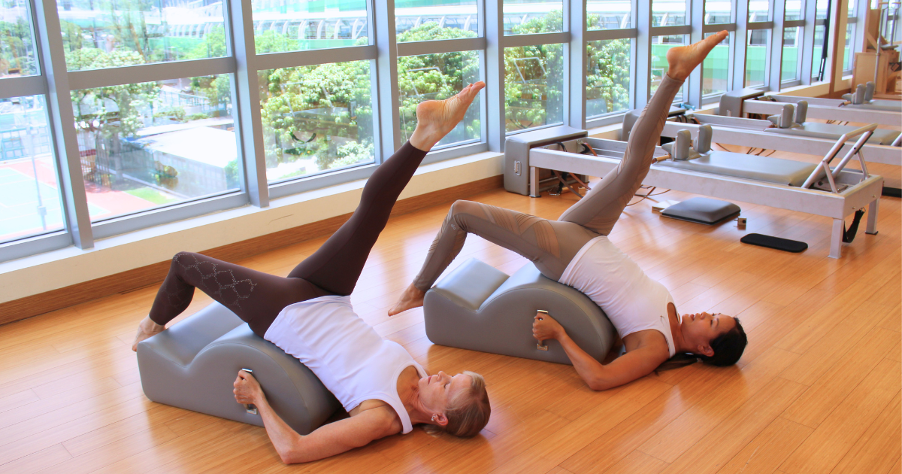
Pilates is often brought into the conversation during pregnancy or postpartum recovery, when the focus shifts to core rehabilitation and pelvic floor support. But to confine its value to that window is to overlook its far more enduring role in women’s health.
Across every stage of life, Pilates offers something quietly powerful. It builds not just strength, but awareness. Not just mobility, but resilience. It becomes a method of understanding the body as it evolves, and responding to it with precision rather than force.
At Flex, this is where the method reveals its depth.
Rethinking the Pelvic Floor
The pelvic floor is often reduced to a set of cues. Engage, lift, hold. In reality, it is a dynamic system that works in constant relationship with the breath, the diaphragm, and the deep stabilising muscles of the trunk.
Pilates reframes pelvic floor training as an integrated practice. Rather than isolating the area, it restores coordination. Breath initiates movement, the deep abdominals respond, and the pelvic floor follows in a natural, reflexive way.
This becomes increasingly important beyond the postpartum phase. Many women experience symptoms of pelvic floor dysfunction later in life, from mild instability to discomfort or urgency, often without connecting it to how they move and hold tension day to day.
Through precise, low-impact work, Pilates retrains these patterns, encouraging responsiveness over rigidity. The result is not just support, but confidence in how the body functions under load, in motion, and at rest.
Hormones, Stress and the Nervous System
Pilates doesn’t directly regulate hormones. What it does is create the conditions in which the body can function more optimally.
Hormonal shifts, whether linked to perimenopause, menopause, or conditions such as PCOS, often bring a cascade of symptoms like disrupted sleep, changes in body composition, and increased stress sensitivity. At the centre of this is the nervous system.
Pilates activates the parasympathetic nervous system and helps lower cortisol levels. Over time, this supports more stable energy, improved recovery, and a greater sense of internal regulation.
There is also a structural dimension. As estrogen levels decline, many women notice changes in fat distribution, particularly through the abdomen. Rather than approaching this cosmetically, Pilates addresses it functionally.
By strengthening the deep core and improving overall muscle support, it contributes to better metabolic health and posture. This creates a more supported, responsive trunk, helping to counter the physical effects often associated with hormonal change.
Bone Density, Strength and the Case for Prevention
Bone health is one of the most overlooked aspects of women’s long-term wellbeing.
Osteopenia and osteoporosis develop gradually, often without symptoms, as bone density declines from the mid-thirties onwards and accelerates through menopause. For many women, the first indication is a fracture rather than a diagnosis.
Pilates offers a proactive approach to prevention.
Through resistance-based work, particularly on the reformer, the body is exposed to controlled load. This mechanical stimulus is essential for maintaining bone density. Unlike high-impact training, Pilates builds this stimulus with precision, supporting joint integrity while still challenging the skeletal system.
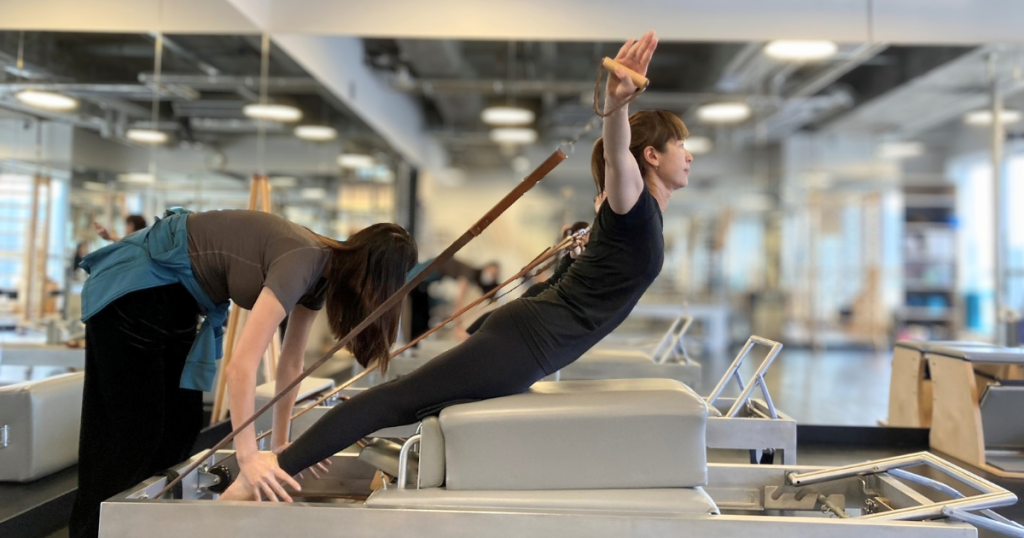
Alignment is equally critical. As bone density decreases, there is an increased risk of postural change, particularly through the spine. Pilates strengthens the back body, supports spinal extension, and reinforces movement patterns that reduce unnecessary strain. Balance and coordination are also developed, and the result is a form of strength that supports longevity, not just in how the body looks, but in how it performs over time.
A Method That Evolves With You
What sets Pilates apart is its adaptability. It’s a system that evolves alongside you. In earlier years, it may focus on building a strong, responsive foundation. In midlife, it becomes a tool for managing stress, maintaining strength, and navigating hormonal change. Later, it supports mobility, balance, and independence.
At Flex, this progression is guided with intention. Whether through ongoing classes or more immersive formats such as Intensives and teacher training, the focus remains the same. Building a body that is not only strong but refined in how it moves and responds.
The Power of Consistency
There is nothing extreme about Pilates. No burnout, no urgency, no quick fixes.
Its impact is cumulative. You’ll notice subtle shifts in alignment, a deeper connection to breath, and strength that builds steadily and supports the body in ways that are often only noticed over time.
For women, this is where true transformation lies. Not in reacting to the body when something goes wrong, but in supporting it, intelligently and consistently, long before it does.
Experience Personalized Classical Pilates at Flex
Ready to unlock Pilates’ transformative power? Book a private assessment at your nearest Flex Studio today. Our certified instructors will customize a session to address your unique needs, from pelvic floor refinement to hormonal resilience and bone health.
Contact our local studio now to get started on a stronger, more balanced you.
CENTRAL
3/F Man Cheung Building, 15-17 Wyndham Street Central
WhatsApp +852 5740 5103
ONE ISLAND SOUTH
2205 & 2209 One Island South, 2 Heung Yip Road Wong Chuk Hang
WhatsApp +852 5740 9420
ORCHARD
390 ORCHARD ROAD, PALAIS RENAISSANCE #05-02 S238871
WhatsApp +65 9016 3539